

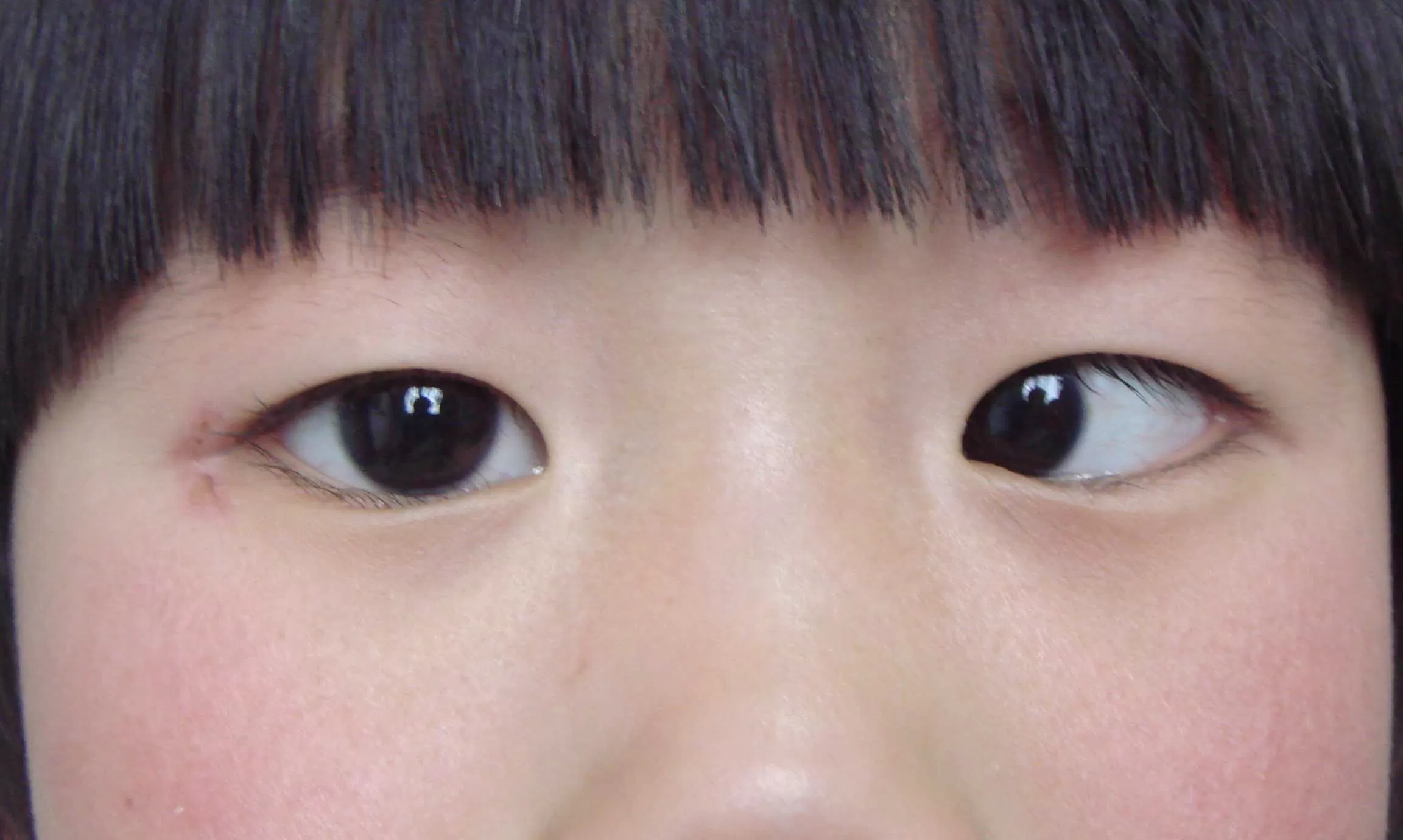
"Mom, why do I always see two shadows when I look at things?" "The teacher says I always tilt my head when reading" — when children's words contain such details, strabismus may be quietly stealing their clear vision. This eye condition, often mistakenly called "crossed eyes" or "wandering eyes" by parents, affects far more than appearance. It prevents the eyes from working together. To avoid double vision, the brain actively suppresses visual signals from the strabismic eye. Over time, this eye may develop "amblyopia" (lazy eye) and even permanently lose stereoscopic vision. This leaves children unable to accurately judge distances in the future, affecting daily activities like driving and painting. Moreover, differences in appearance may trigger inferiority in social interactions at school.
Medically, strabismus is not a single disease but a group of complex disorders involving abnormal extraocular muscle function. There is esotropia, where the eyes converge inward when looking at near objects (common in toddlers aged 2-3). Exotropia occurs when the eyes deviate outward when looking at distant objects (usually appearing in school-age children, often manifested as "wandering eyes when distracted"). Vertical strabismus, where the eyes shift up or down, easily causes children to habitually tilt their heads or look sideways. Long-term, this may lead to cervical spine development issues. More challenging is that about 30% of strabismus patients have complications such as anisometropia (a difference of over 150 degrees between the two eyes), congenital cataracts, and fundus lesions. This means treatment cannot only "adjust eye position" but must also consider overall eye health. Globally, there are few expert teams capable of accurately handling such complex cases.
Medical research has long confirmed that children's visual development has a strict "golden window period." For esotropia patients intervened before the age of 2, the recovery rate of binocular visual function can exceed 85%. Even for intermittent exotropia, standardized treatment between 4-6 years old can effectively prevent progression to permanent strabismus. However, in reality, many international families miss the optimal treatment time due to limited local medical resources and delayed diagnosis, facing the regret of irreversible damage to their children's vision.
Dr. Liang took the lead in launching systematic treatment for pediatric glaucoma, cataracts, and fundus diseases at Beijing Children's Hospital. While completing over 1,000 infant cataract surgeries, he accumulated rich experience in evaluating and adjusting extraocular muscle function. This interdisciplinary background allows him to handle complex cases such as "strabismus + fundus lesions" and "strabismus + anisometropia" with ease. For example, when treating a strabismus patient with persistent fetal vasculature, he designed simultaneous fundus examination and eye position correction plans. This avoided the delay risk of "treating strabismus first, then examining the fundus" in traditional treatment. For such patients, performing extraocular muscle surgery first may cause a sudden increase in postoperative intraocular pressure due to abnormal fundus blood vessels. Dr. Liang's "simultaneous diagnosis and treatment thinking" avoids this danger at the source.
Dr. Liang's team integrates advanced international non-surgical and surgical plans to create a "personalized treatment matrix" for different types of strabismus:
1. Non-surgical plan: For young children or those intolerant to surgery, modified botulinum toxin A injection therapy is adopted. Unlike traditional injection techniques, the team innovatively uses "extraocular muscle fixation forceps" to accurately locate muscle positions, controlling the drug injection error within 0.1 millimeters. This completely avoids the risk of globe perforation caused by operational deviations. The entire treatment process requires only local anesthesia without general anesthesia. Children can complete the procedure in 10 minutes while awake and play normally the same day. It is particularly suitable for esotropia patients under 2 years old.
2. Surgical plan: For complex strabismus (such as congenital paralytic strabismus and secondary strabismus), "precision quantitative surgery" is performed. Preoperative 3D extraocular muscle function evaluation system accurately measures the strength, tension, and attachment position of each extraocular muscle. Intraoperatively, absorbable sutures and microsurgical techniques are used to reduce surgical trauma to the millimeter level. More importantly, breaking the traditional "one-size-fits-all" surgical model, Dr. Liang's team flexibly adjusts the amount of muscle shortening or recession according to the child's eye movement characteristics. For example, in cases of exotropia combined with vertical deviation, horizontal and vertical eye positions are corrected simultaneously, avoiding the pain of secondary surgery for children.
3. Postoperative rehabilitation closed-loop: Regardless of surgery, the team customizes "amblyopia training + visual function recovery" plans for each child. Adopting international mainstream training methods such as CAM visual stimulation and red light flicker, combined with RGP (rigid gas-permeable contact lens) fitting guidance (especially suitable for anisometropia patients), it ensures that binocular visual function recovers synchronously after eye position correction. This truly achieves "not only seeing straight but also seeing clearly and stereoscopically."
As the first author, Dr. Liang has published 12 national core papers and 7 SCI papers. He always transforms scientific research achievements into clinical advantages. His multicenter study on penetrating Schlemm's canaloplasty explores the correlation between intraocular pressure regulation and extraocular muscle function. This research allows him to accurately judge the impact of intraocular pressure changes on extraocular muscle tension when treating strabismus patients with glaucoma. He formulates personalized plans of "stabilizing intraocular pressure first, then adjusting eye position." The international success rate for such cases is usually less than 60%, while the effective rate of Dr. Liang's team reaches 92%.
What attracts global patients here is not only top-tier medical skills but also a comprehensive international medical security system:
The hospital has served patients from over 100 countries. It is equipped with a multilingual team proficient in English, Japanese, Russian, etc., providing full-process services from visa assistance to insurance claims. The 24-hour medical concierge team can assist with online appointments and translate inspection reports, eliminating language and procedural barriers to medical treatment. For example, for child patient families from Africa, the concierge team prepares the necessary diagnostic certificates and treatment plan summaries for medical visas in advance, and even arranges airport pickup services in Beijing, sparing parents from rushing around in an unfamiliar city.
Considering the adaptation needs of international children, the hospital has created a warm and childlike consultation space. The walls of the ophthalmology clinic area are painted with cartoon animal patterns. Examination rooms are equipped with animation playback devices that children love. Even eye drops are designed with fruit flavors. The inspection equipment is specially adapted for young children. For instance, Teller card vision testing (judging vision through children's gaze responses to different pattern cards) replaces traditional eye charts, minimizing children's fear of medical treatment. Many parents from Europe feedback: "The environment here makes children not afraid of seeing doctors at all; they even look forward to the next follow-up visit."
Detailed cost estimates for initial consultations, examinations, and treatments are provided in advance. Multiple international payment methods are supported (Visa, MasterCard, UnionPay, and mainstream digital currencies). Cooperation has been established with many global insurance institutions (such as Aetna and Cigna) to simplify the claims process. Parents receive a clear fee list when making an appointment. For example, the cost of botulinum toxin injection therapy includes all items such as drugs, operations, and postoperative follow-ups, with no hidden charges. This allows parents to not worry about medical expenses.
In Dr. Liang Tianwei's consulting room, there are many warm stories of "regaining clarity":
4. Xiao Yu, a 3-year-old boy from Thailand, suffered from congenital esotropia combined with amblyopia. He tried glasses correction at local hospitals with no effect. His parents took him to seek medical treatment in 3 countries. After evaluation by Dr. Liang, modified botulinum toxin injection therapy was adopted. His eye position basically returned to normal after 1 month. With subsequent amblyopia training, his eyesight improved from 0.2 to 0.8 in 3 months. Now, Xiao Yu can clearly see the details in picture books and actively share with his mother: "The birds in the sky have pointed beaks."
5. A Chinese family residing in Germany specially brought their 7-year-old daughter Meng Meng to Beijing. Meng Meng suffered from intermittent exotropia combined with 200-degree anisometropia. German doctors recommended traditional surgery, but her parents worried that surgical trauma would affect their daughter's future eye development. Dr. Liang's team formulated a "non-surgical correction + visual training" plan for Meng Meng. By using customized prism glasses to control eye position and combining with binocular visual function training, the frequency of Meng Meng's exotropia episodes decreased from more than 10 times a day to 1-2 times a month after 6 months. Her stereoscopic vision function also improved significantly. Now she can independently complete activities requiring fine vision such as puzzles and building Lego blocks.
As an American mother wrote in her thank-you letter: "The experts here not only understand medicine but also children — they 换来 the clearest future with minimal trauma. We originally thought we would need to travel back and forth multiple times, but unexpectedly, the entire process from initial consultation to treatment completion only took 2 months. With special personnel following up throughout, this professionalism and thoughtfulness made us extremely at ease."
If your child has the following symptoms, be alert to the possibility of strabismus:
6. Often squinting, tilting the head to look at objects, or complaining of "seeing double."
7. Obvious deviation of eye position (inward, outward, or up and down), especially when distracted.
8. Inaccurate judgment of distance, such as easily knocking over objects when picking them up or being cautious when going up and down stairs.
If your child has been diagnosed with strabismus, please contact Dr. Liang Tianwei's team via email: tony.li@jdetyy.com. We will provide:
1. Multilingual video initial consultation and evaluation (supporting English, Japanese, Korean, Russian, etc.), allowing you to obtain professional diagnosis without long-distance travel.
2. Formulation of personalized treatment plans, selecting the most suitable treatment method based on the child's age, type of strabismus, and comorbidities.
3. Full-process dedicated follow-up from consultation to rehabilitation, including assisting with appointment scheduling, translating medical reports, and arranging postoperative follow-ups.
In Beijing, an international metropolis integrating tradition and modernity, Dr. Liang Tianwei's team is building a bridge to clear vision for strabismus patients worldwide with professionalism and warmth. We believe that every pair of eyes deserves to see the beauty of the world, and every child can have a future without strabismus.

 EN
EN
 CN
CN